 Translate
Cleveland Development Project
Project Year
2011
Project Duration
6 months
Contaminants of Concern
Remediation Technologies Used
- • Enhanced Reductive Dechlorination
- • Compressed Nitrogen Injection
- • EHC-M Substrate
- • Chemical Reduction
Key Results
- ✓Over 90% TCE reduction achieved
- ✓Vinyl chloride reduced below regulatory standards
- ✓Hexavalent chromium successfully reduced to trivalent form
- ✓Sustainable biological activity established
Target Contaminants
Site Background
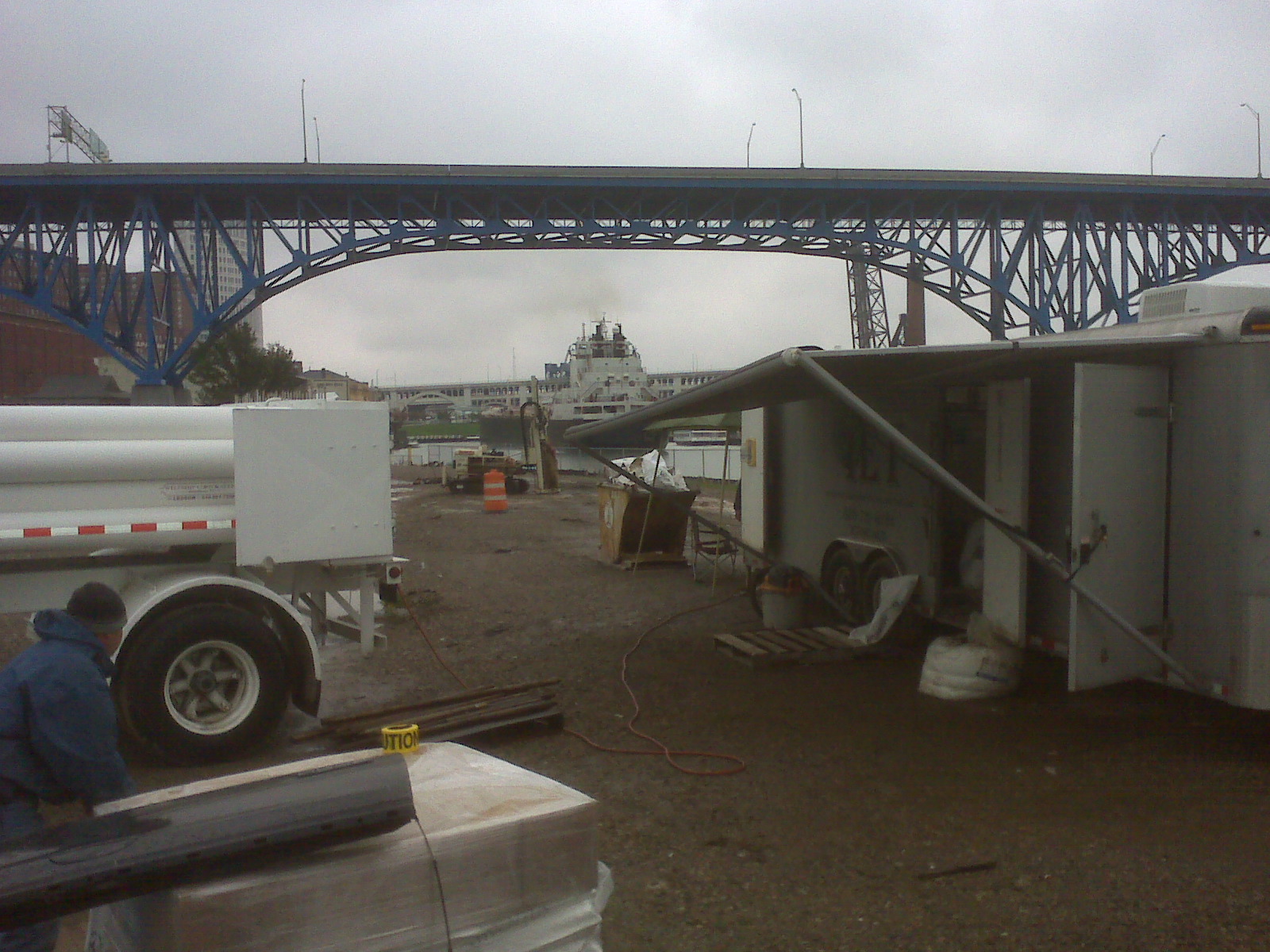
The remediation site is located in the Cleveland Flats development area in Cleveland, Ohio. The site contained soil and groundwater impacted by multiple chlorinated solvents including trichloroethene (TCE), cis-1,2-dichloroethene (cis-1,2-DCE), vinyl chloride, as well as hexavalent chromium contamination.
Historical industrial activities in the area resulted in widespread contamination that required an innovative approach to address multiple contaminant types simultaneously.
Remediation Strategy
IET designed and implemented a comprehensive in-situ injection program utilizing compressed nitrogen for reagent delivery along with a specialized solution containing:
- EHC-M (Enhanced Reductive Dechlorination substrate)
- Calcium propionate as an electron donor
- Oxygen scavenger to create anaerobic conditions
The injection program targeted the source areas and downgradient plume to address both chlorinated solvents through enhanced bioremediation and hexavalent chromium through chemical reduction.
Implementation
IET's field technicians utilized direct-push injection technology to deliver the treatment solution at multiple depths and locations across the site. The compressed nitrogen delivery system ensured thorough distribution of reagents throughout the treatment zone.
Multiple injection points were strategically placed to achieve comprehensive coverage of both soil and groundwater contamination zones.
Results
Post-treatment monitoring demonstrated significant reductions in target contaminant concentrations:
- TCE concentrations reduced by over 90%
- Vinyl chloride levels decreased below regulatory standards
- Hexavalent chromium successfully reduced to trivalent form
- Sustainable reduction achieved through biological activity
The project successfully met remediation objectives and allowed the development project to proceed on schedule.
Technical Approach & EHC-M for Mixed Contamination
This Cleveland Flats project demonstrates IET's capability to treat mixed contamination — both chlorinated solvents (TCE, cis-1,2-DCE, vinyl chloride) and hexavalent chromium — in a single injection program. The EHC-M amendment combines controlled-release organic carbon with zero-valent iron (ZVI) to create strongly reducing conditions that simultaneously drive enhanced reductive dechlorination (ERD) of chlorinated solvents and chemical reduction of hexavalent chromium (Cr⁶⁺) to the less toxic and less mobile trivalent form (Cr³⁺).
The compressed nitrogen delivery system used for this project is a key differentiator. Nitrogen gas provides several advantages over conventional water-based injection: it displaces oxygen to rapidly establish anaerobic conditions, it enhances reagent distribution through gas-phase transport in preferential pathways, and it does not introduce oxygen that would inhibit the reducing conditions needed for both dechlorination and chromium reduction. The calcium propionate electron donor provides sustained hydrogen release for biological treatment, while the oxygen scavenger ensures rapid transition to anaerobic conditions.
The 90%+ TCE reduction, vinyl chloride reduction below regulatory standards, and successful hexavalent chromium reduction to trivalent form demonstrate the effectiveness of this multi-contaminant treatment approach. The sustainable reduction achieved through biological activity confirms that the EHC-M amendment successfully established self-sustaining treatment systems for both contaminant classes — providing long-term treatment without the need for repeated mobilizations.
Cleveland Flats Site Context & Ohio Geology
The Cleveland Flats is a historic industrial area along the Cuyahoga River in Cleveland, Ohio, where over a century of manufacturing, chemical processing, and steel production have left legacy contamination in soil and groundwater. The shallow geology consists of Quaternary-age alluvial and lacustrine deposits — predominantly clay, silt, and sand from Lake Erie and river deposits — overlying Devonian-age shale bedrock. These deposits create moderate-permeability conditions suitable for in-situ remediation via direct push injection.
The mixed contamination at this site — chlorinated solvents plus hexavalent chromium — is characteristic of former industrial sites where multiple manufacturing processes used different chemical suites. Hexavalent chromium was commonly used in plating operations, while chlorinated solvents were used for degreasing. The EHC-M amendment's ability to treat both contaminant classes in a single injection event is a significant advantage at these complex industrial sites, eliminating the need for separate treatment programs for each contaminant type. The project's success enabled the Cleveland Flats development project to proceed on schedule.
