In Situ Injection Services for Environmental Remediation
Turn-key delivery of ISCO, bioremediation, ISCR, and EZVI reagents via direct push, permanent well, and in situ soil mixing — engineered for your site geology and contaminant distribution.
What Are In Situ Injection Services?
In situ injection delivers chemical or biological treatment reagents directly into contaminated soil and groundwater — treating contamination in place, without excavation, without soil removal, and without above-ground treatment systems. The contaminant is destroyed or stabilized where it sits.
IET has specialized in in situ injection for over 28+ years, developing patented tooling, licensed technologies, and a turn-key field delivery capability that no other contractor can match. From a single pilot test to a 500-point full-scale program, IET handles the entire injection workflow — design, reagent procurement, mixing, delivery, monitoring, and reporting.
Injection Delivery Methods
The right delivery method is critical to treatment success. IET engineers the optimal approach based on your site geology, contamination depth, and access constraints.
IET's patented direct push injection tooling has been designed in-house and field-tested over 28+ years of active remediation work. Reagents are delivered at precise depths through sacrificial or retrievable injection points, with no waste streams generated.
- No waste streams or drill cuttings generated
- Precise depth and volume control per injection point
- Rapid mobilization — minimal surface disruption
- Suitable for tight access, interior, and urban sites
- Patented multi-port tooling maximizes radius of influence
- Real-time pressure and flow monitoring
IET injects through existing monitoring wells, recovery wells, and abandoned SVE systems, dramatically reducing implementation costs at sites with existing infrastructure. Well manifold systems allow simultaneous multi-point distribution across large plumes.
- Leverages existing site infrastructure
- Well manifold systems for multi-point distribution
- Straddle packer assemblies for precise zone isolation
- Open rock well injections via gravity or pressure
- Gravity-feed, peristaltic, and pneumatic pump options
- Automated injection systems for long-duration programs
IET uses large-diameter augers and mixing paddles to mechanically blend chemical or biological reagents directly into contaminated soil. Ideal for NAPL source zones, tight soils, and shallow saturated zones where fluid injection has limited radius of influence.
- No excavation or hazardous waste disposal required
- Superior reagent distribution in low-permeability soils
- Effective for VOCs, NAPL, PAHs, and metals
- Treats saturated and unsaturated zones simultaneously
- Combines chemical and physical treatment in one pass
- Exclusive licensed technology — not available elsewhere
Reagents IET Injects
IET is reagent-agnostic and holds patents on our own ferric iron-activated persulfate formulation. We select and deliver the chemistry best suited to your contaminants, geology, and regulatory goals — and we mix everything on-site with full QA/QC documentation.
Ferric Iron-Activated Persulfate
TCE, PCE, BTEX, DNAPL — patented IET formulation providing 2+ year sustained oxidation
Potassium Permanganate
TCE, PCE, DNAPLs — high oxidant demand sites
Sodium Persulfate
Chlorinated solvents and petroleum with various activation methods
Catalyzed Hydrogen Peroxide (Fenton's)
Petroleum hydrocarbons, BTEX, mixed contamination
Electron Donors (EVO, HRC, Lactate)
Enhanced reductive dechlorination of chlorinated solvents
Bioaugmentation Cultures (SDC-9, KB-1)
Complete dechlorination of TCE/PCE to ethene
Zero Valent Iron (ZVI / nano-ZVI)
Abiotic reduction of chlorinated solvents and metals
Emulsified ZVI (EZVI)
DNAPL source zone treatment — NASA-developed technology
Calcium Polysulfide
Hexavalent chromium reduction and heavy metals stabilization
Ferrous Sulfate / Iron Salts
Chromate reduction, co-precipitation of dissolved metals
Custom Blended Reagents
Mixed contamination — ISCO + bioremediation sequential or combined
pH Adjustment / Buffers
Site conditioning prior to primary reagent injection
IET's Injection Process: Start to Finish
From design through reporting — IET handles every step so your consultant and PM have one accountable turn-key contractor.
Site Characterization Review
IET reviews all available boring logs, groundwater data, CSM, and regulatory documents. We identify injection target zones, confirm contaminant distribution, and flag site-specific challenges before mobilization.
Injection Design
Our engineers develop a site-specific injection design specifying reagent type, concentration, volume per point, injection grid spacing, target intervals, and delivery method — all tailored to geology, contaminant mass, and project goals.
Reagent Procurement & Mixing
IET procures, stores, and mixes all reagents. We operate certified mixing systems with QA/QC logging of concentration, volume, and batch records. Our field crews are trained in safe handling of all oxidants, reductants, and biological materials.
Field Mobilization
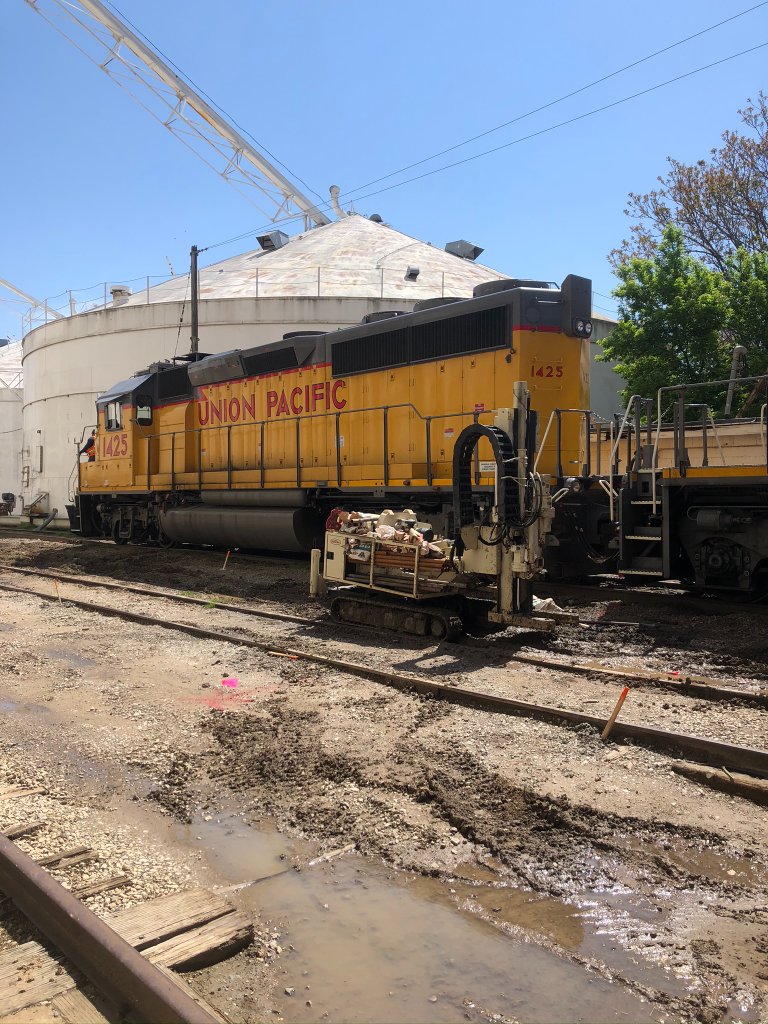
IET maintains a fleet of 50+ direct push, rotary, and specialty rigs with same-week mobilization capability. Our self-contained units carry all reagents, injection equipment, and safety gear — no subcontractors needed.
Injection Execution & Monitoring
During injection, IET field crews track and log pressure, flow rate, volume, and depth for every injection point. Real-time adjustments ensure reagent delivery meets design specifications and formation response is documented.
Reporting & Follow-Up
IET prepares complete injection summary reports documenting reagent volumes, delivery pressures, injection logs, and post-injection monitoring data. Reports are designed to meet state regulatory requirements and satisfy consultants and project managers.
Injection Approach by Geology
Geology is the most important factor in injection design. IET has injected in virtually every subsurface formation type found across North America.
| Geology / Formation | Recommended Method |
|---|---|
| Sandy Aquifers | Direct Push + Permanent Wells |
| Silty / Fine-Grained Soils | Direct Push with High-Pressure Injection |
| Clay / Low-Permeability | Hydraulic Fracturing or Soil Mixing (ISGS) |
| Fractured Bedrock | Open-Hole Well Injection |
| Glacial Till / Mixed | Direct Push + Multi-Point Wells |
| Marine / Riverine | Barge-Mounted Direct Push |
Why Choose IET for Injection Services?
IET was founded in 1998 with a singular focus: deliver better in situ remediation results through better injection technology. Over 28+ years, we've built patented tooling, licensed exclusive technologies, and trained field crews that have completed more injection projects than any comparable firm.
- Patented ferric iron-activated persulfate — sustained oxidation, no rebound, exclusive to IET
- 3,500+ completed injection projects across 40+ states since 1998
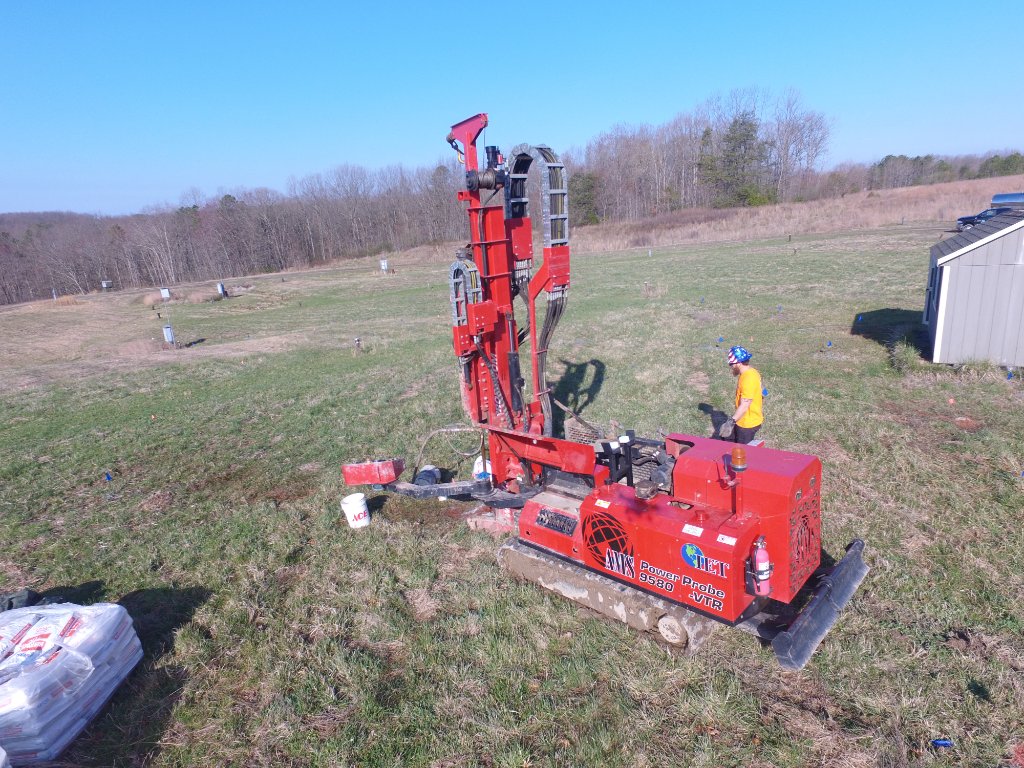
- 50+ specialized rigs — GeoProbe, CME, AMS, barge — owned and operated by IET
- Experienced field crews — no subcontractors, IET employees on every project
- Same-week mobilization capability for emergency response and urgent programs
- Full turn-key: design, reagent procurement, mixing, delivery, monitoring, reporting
Ferric Iron-Activated Persulfate: The IET Difference
IET holds patents on ferric iron-activated persulfate — a unique ISCO formulation where ferric iron activates persulfate to generate highly reactive sulfate radicals. Unlike permanganate or standard persulfate, IET's formulation provides sustained oxidation lasting 2+ years, dramatically reducing the risk of post-treatment contaminant rebound.
Chemical Injection: ISCO Chemistries & Challenges
Chemical oxidation (ISCO) is the most common application for in situ injection. Understanding which oxidant to inject — and the challenges that follow — is critical to treatment success.
Which Oxidant Does IET Inject?
Ferric Iron-Activated Persulfate
IET PatentedTargets: TCE, PCE, BTEX, DNAPLs
IET patented — sustained 2+ year action, prevents rebound
Potassium Permanganate
Targets: TCE, PCE, DNAPLs
Long persistence; forms MnO₂ precipitate — monitor NOD demand
Catalyzed H₂O₂ (Fenton's)
Targets: Petroleum, BTEX, mixed
Fast reaction; short persistence; effective in high-permeability zones
Sodium Persulfate (heat/alkaline)
Targets: Chlorinated solvents, petroleum
Flexible activation; good persistence; cost-effective for large volumes
The #1 ISCO Injection Challenge: Rebound
Analysis of 59 chlorinated solvent DNAPL sites shows that most conventional ISCO programs achieve initial concentration reduction — but experience contaminant rebound within 1–3 years once the oxidant is consumed and contaminants desorb from the aquifer matrix.
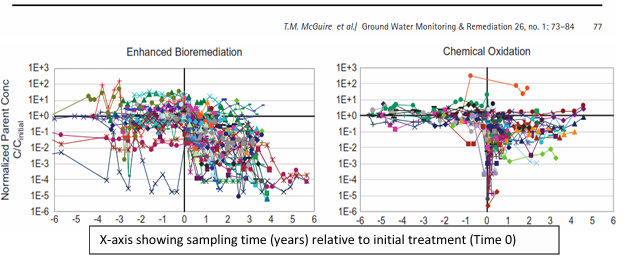
McGuire et al (2006) — ISCO (right) shows more rebound than bioremediation (left) across 59 DNAPL sites
IET's Solution: Ferric Iron Chemistry
IET's patented ferric iron-activated persulfate generates iron and sulfate byproducts that serve as electron acceptors for bacteria — sustaining biological degradation for 2+ years after injection, eliminating rebound at treated sites.
Other Common ISCO Injection Challenges — and How IET Addresses Them
NOD / Reagent Demand
Organic matter consumes oxidant before reaching contaminants. IET pre-characterizes NOD and sizes reagent volumes accordingly.
Low Permeability Soils
Clay and silt limit reagent distribution. IET uses hydraulic fracturing, high-pressure injection, or soil mixing (ISGS) to overcome this.
DNAPL Source Zones
Dense non-aqueous phase limits contact. IET uses EZVI or high-volume persulfate programs specifically designed for DNAPL dissolution.
Reagent Distribution
Uneven distribution leaves untreated pockets. IET's patented multi-port tooling and pressure monitoring ensure complete coverage.
Biological Injection: Bioremediation Delivery & Challenges
Injecting biological amendments — electron donors, bioaugmentation cultures, and nutrient packages — requires different design considerations than chemical injection. IET has injected bioremediation substrates at hundreds of sites.
What IET Injects for Bioremediation
Controlled-Release Electron Donors
Products: Provect-IR, EVO, HRC, vegetable oil emulsions
Sustained anaerobic conditions for reductive dechlorination of PCE/TCE
Soluble Substrates
Products: Sodium lactate, molasses, ethanol
Rapid establishment of reducing conditions; used for plume edges
Bioaugmentation Cultures
Products: SDC-9, KB-1, DHC (Dehalococcoides)
Complete dechlorination at sites without native degraders
Zero Valent Iron (ZVI)
Products: Nano-ZVI, micro-ZVI, granular ZVI
Abiotic reductive dechlorination; PRB installation
Oxygen Release Compounds
Products: ORC, calcium peroxide, MgO₂
Aerobic conditions for petroleum hydrocarbon biodegradation
Reductive Dechlorination: The Injection Pathway
IET injects electron donors to drive the sequential anaerobic breakdown of chlorinated solvents — each step requiring the right geochemical conditions in the target zone.
Bioaugmentation with Dehalococcoides ensures complete dechlorination to non-toxic ethene
Bioremediation Injection Challenges
Vinyl Chloride Stall
Bioaugmentation with Dehalococcoides cultures that perform complete dechlorination
Substrate Distribution in Clays
IET uses soil mixing (ISGS) or hydraulic fracturing to distribute substrates in low-K zones
Short-Circuiting / Preferential Flow
Dense injection grid + multiple depth intervals ensure substrate reaches the entire treatment zone
Geochemical Conditions
pH buffering and sulfate/iron management pre-injection to optimize reducing conditions
Sequential Treatment: ISCO Injection Followed by Bioremediation Injection
IET frequently combines both approaches at the same site: ISCO injection rapidly destroys the source area, then bioremediation injection addresses the residual dissolved plume. This strategy leverages the speed of ISCO and the sustainability of biology for complete site cleanup.
Phase 1: ISCO
Direct push persulfate injection destroys 90–99% of source area mass in weeks to months
Phase 2: Transition
Monitor geochemistry; confirm oxidant exhaustion; design bio injection program
Phase 3: Bioremediation
Electron donor + bioaugmentation injection sustains treatment for the dissolved plume for 2–5 years
Injection Services: Featured Case Studies
Real results from IET injection programs — organized by chemistry and biology application
Chemical Oxidation (ISCO) Injection
ISCO Technology GuideEastern PA Manufacturing
Eastern PA
Persulfate ISCO Injection
99.99% TCE reduction from 24 mg/L in active operational facility
Mentor Avenue, OH
Mentor, OH
Persulfate PRB Injection
Patented ferric iron persulfate PRB for chlorinated solvent plume downgradient of source
Parvin Road, Prosper TX
Prosper, TX
Persulfate ISCO — Active Site
Large-scale persulfate injection at operational manufacturing facility
Bioremediation Injection (ERD / EVO / Bioaugmentation)
Bioremediation Technology GuideSanitary Cleaners, NC
North Carolina
ERD — Electron Donor Injection
96.6% TCE reduction via enhanced reductive dechlorination
East Windsor Industrial
East Windsor, CT
Bioremediation — ISGS Soil Mixing
100% reduction of chlorinated compounds in clay geology in 180 days
St. Albans, WV
St. Albans, WV
ISCO + Bioremediation Sequential
Combined ISCO and bioremediation injection for BTEX, MTBE and TBA in clay
NAPL / Source Zone & Specialty Injection (ISGS, EZVI)
ISGS Technology GuideGainesville Creosote Site
Gainesville, FL
ISGS — In Situ Soil Mixing Injection
83% DNAPL reduction on 90-acre MGP site with significant cost savings vs excavation
Brooklyn NY ISGS Pilot
Brooklyn, NY
ISGS Pilot — Urban NAPL Site
ISGS pilot test for MGP site in dense urban environment with limited access
Fanwood Coal Tar Site
Fanwood, NJ
ISGS Soil Mixing Injection
Eliminated 5+ feet of free product in 30 days at former MGP site
Injection by Contaminant Type
Each contaminant class requires a specific injection chemistry, delivery strategy, and performance expectation. Explore IET's dedicated pages by contaminant:
TCE / PCE — Chlorinated Solvent Injection
Persulfate ISCO, ERD, bioaugmentation, EZVI, ISCR
Petroleum Hydrocarbons (BTEX, TPH)
Fenton's ISCO, oxygen release, aerobic bioremediation
DNAPL / Source Zone Treatment
EZVI, high-volume persulfate, ISGS soil mixing
Creosote / Coal Tar / MGP Sites
ISGS soil mixing, permanganate, ISCO + bio sequential
Heavy Metals — Chromium, Lead
Calcium polysulfide, ferrous sulfate, ZVI injection
Mixed / Co-mingled Contamination
Sequential ISCO + bioremediation, custom blended reagents
Related Services & Technologies
Injection Services: Frequently Asked Questions
Ready to Discuss Your Injection Program?
IET provides free technical consultations for injection projects of any scale. Our engineers will review your site data and recommend the optimal delivery method and reagent strategy.