Persulfate Activation & ISCO Remediation Services — In Situ Chemical Oxidation
IET's patented ISCO technologies rapidly destroy TCE, PCE, BTEX & petroleum contaminants in soil and groundwater — achieving site closure faster with sustained bioremediation to prevent rebound. Request a free evaluation.
How ISCO Chemical Oxidation Works
ISCO involves the injection of chemical oxidants into contaminated soil and groundwater to chemically convert hazardous contaminants into non-hazardous or less toxic compounds, primarily carbon dioxide and water.
The process accelerates the natural oxidation process, achieving in months what might otherwise take decades through natural attenuation.
ISCO Oxidant Types
- Permanganate: Effective for chlorinated solvents and PAHs
- Hydrogen Peroxide: Rapid oxidation of petroleum hydrocarbons
- Persulfate: Long-lasting oxidant for sustained treatment
- Ozone: Powerful oxidant for rapid response
- Ferrate (Fe⁶⁺): Supercharged iron species generated by IET's ferric iron-activated persulfate system — dual-action oxidant and coagulant with 2.20V oxidation potential for direct contaminant destruction and simultaneous aquifer improvement
Target Contaminants
Petroleum Hydrocarbons
- • BTEX compounds
- • Gasoline (BTEX)
- • Diesel fuel
- • Heating oil
Chlorinated Solvents
- • TCE / PCE
- • 1,1,1-TCA
- • Carbon tetrachloride
- • Chloroform
Other Compounds
- • PAHs
- • MTBE
- • Phenols
- • SVOCs
Key Advantages
Rapid Treatment
Achieves significant contaminant reduction in weeks to months, much faster than biological methods.
In Situ Application
No excavation required - treatment occurs underground with minimal site disruption.
Complete Destruction
Converts contaminants to harmless end products rather than transferring them elsewhere.
Cost-Effective ISCO
Reduces long-term monitoring costs and accelerates site closure timelines.
Advanced Persulfate Chemistry & Multiple Oxidation Mechanisms
IET employs ferric iron-activated persulfate technology that generates multiple powerful oxidants simultaneously, providing superior contaminant destruction and long-term performance through sustained secondary bioremediation.
Activation Mechanism
S2O8-2 + Fe+3 → Fe(+4 to +6) + SO42- + SO42-•
Ferric iron activation generates supercharged iron (ferrate) and persulfate radicals
Persulfate Radical (SO4•-)
Primary oxidant - powerful free radical with 2.60V oxidation potential
Ferrate (Fe+6)
Supercharged iron species with 2.20V potential - direct contaminant oxidation
Persulfate (S2O8-2)
Extended oxidation capacity - 2.01V potential for long-term treatment
Oxidation Potential Comparison
| Oxidant | Oxidation Potential (Volts) |
|---|---|
| Fluorine (F2) | 2.87 |
| Hydroxyl radical (OH•) | 2.80 |
| Persulfate radical (SO4•-) | 2.60 |
| Ferrate (Fe+6) | 2.20 |
| Ozone (O3) | 2.08 |
| Persulfate (S2O8-2) | 2.01 |
| Hydrogen peroxide (H2O2) | 1.78 |
| Permanganate (MnO4-) | 1.68 |
| Chlorine (Cl2) | 1.49 |
Yellow highlighted rows: Multiple oxidants generated simultaneously by IET's ferric iron-activated persulfate system
Practiced ISCO Chemistries
⚠️Contaminant Rebound: A Critical ISCO Challenge
The most significant problem with conventional ISCO is contaminant rebound. Research analyzing 59 chlorinated-solvent sites shows that most ISCO treatments achieve initial contaminant reduction but experience rebound within a few years when oxidants are exhausted and contaminants desorb from the aquifer matrix.
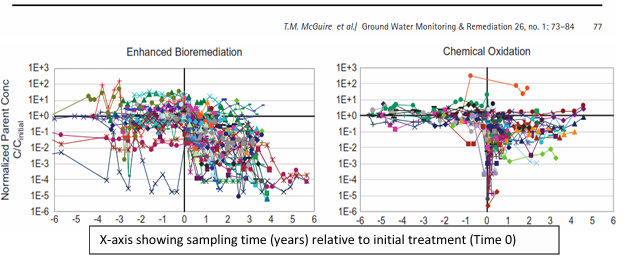
Source: McGuire et al (2006) - Analysis of 59 DNAPL sites showing Chemical Oxidation (right) exhibits more rebound than Enhanced Bioremediation (left)
IET's Solution: Enhanced Bioremediation Through Ferric Iron Chemistry
IET's ferric iron-activated persulfate technology manages rebound through sustained secondary biological treatment lasting >2 years:
- Iron as Terminal Electron Acceptor: Ferric iron (Fe3+) accepts electrons from facultative bacteria, reducing to Fe2+ which can reactivate persulfate in redox cycling
- Sulfate as Electron Acceptor: Generated sulfate (SO42-) supports sulfate-reducing bacteria for long-term contaminant degradation
- Degradation Intermediates as Electron Shuttles: Oxidation products and humic acids facilitate Fe3+ reduction to Fe2+, sustaining treatment
- Pyrite Formation: Ferrous iron + sulfide → FeS2 (pyrite) provides reactive sites for contaminant precipitation and long-term removal
- Multi-Year Longevity: Iron remains active for years (vs oxygen release compounds exhausted in months)
Persulfate Resources
Explore our comprehensive resources on persulfate-based oxidation technologies, including case studies, technical documentation, and patented innovations.
Case Studies
Technical Documents
IET's ISCO Approach
Our experienced team designs customized ISCO programs based on site-specific conditions, contaminant types, and remediation goals. We conduct thorough site characterization, treatability studies, and pilot testing to optimize oxidant selection and delivery methods.
With over 28+ years of experience and 3,500+ remediation events, IET delivers proven ISCO solutions that achieve regulatory closure efficiently and economically.
ISCO Remediation: Frequently Asked Questions
Related Resources
Related Case Studies
See real-world examples of how we've successfully applied this technology