 Translate
Direct-Push Injection vs. Permanent-Well Injection
The two primary delivery methods for in situ remediation reagents each have distinct advantages. Understanding when to use direct-push vs. permanent wells — and when to combine them — is critical for cost-effective treatment design.
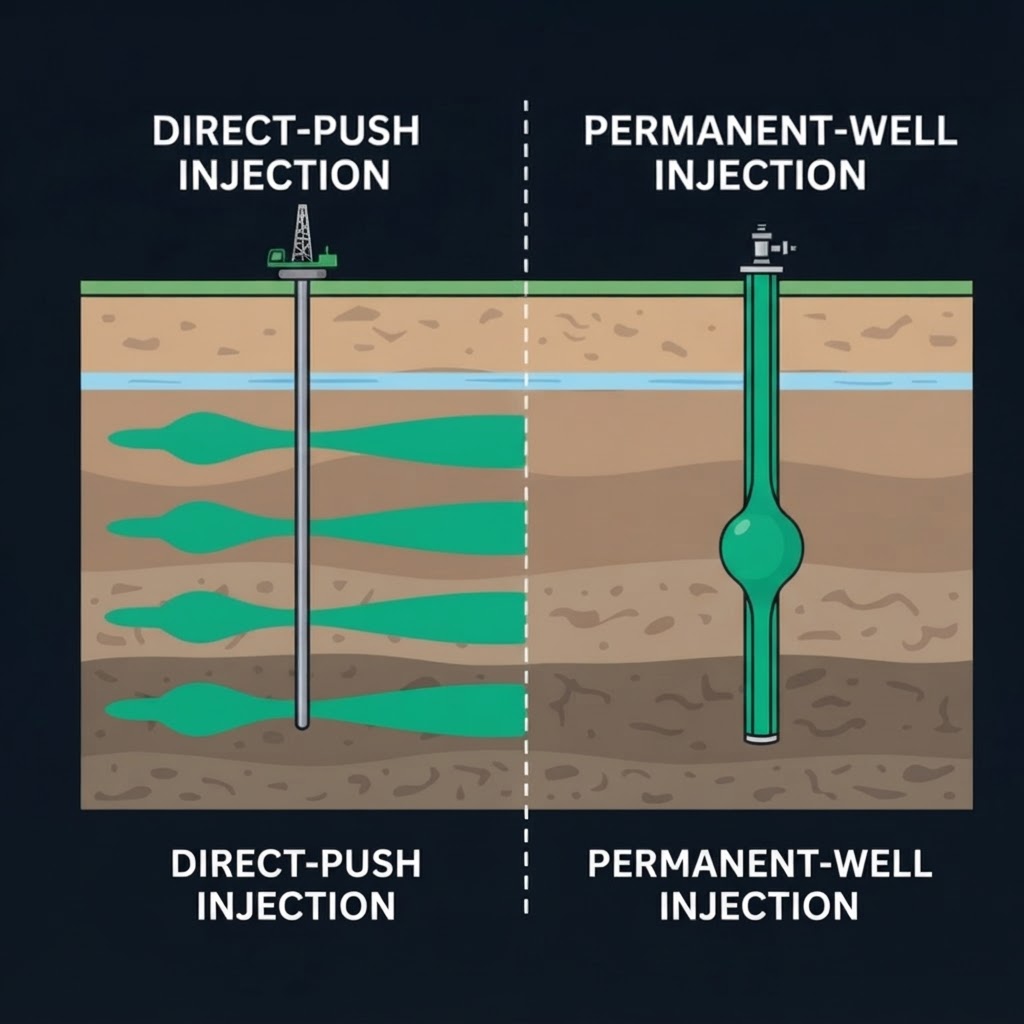
Direct-Push Injection
Steel drill rods are pushed to the target depth by a direct-push rig (Geoprobe/DPT). Reagent is injected at precise depth intervals as rods are withdrawn. No permanent well is left behind — each point is sacrificial.
- Fast mobilization and setup
- Precise depth control
- Minimal surface footprint
- Lower cost for single events
- No well construction needed
Permanent-Well Injection
Dedicated injection wells or repurposed monitoring wells are constructed with screened intervals in the target treatment zone. Reagent is injected through the well casing, allowing repeated treatment events over time.
- Reusable for multiple events
- Ideal for recirculation systems
- Works in any geology
- Lower cost per event over time
- Can use existing monitoring wells
Side-by-Side Comparison
| Factor | Direct-Push | Permanent Well |
|---|---|---|
| Installation | Steel rods pushed to depth, no permanent structure | Wells drilled, cased, and screened in target zone |
| Depth Range | Up to 100+ ft (Geoprobe/DPT); deeper with HSA | Virtually unlimited — limited only by drilling method |
| Best For | Single-event ISCO, bioremediation, ISCR treatments | Multi-event programs, recirculation, long-term delivery |
| Surface Footprint | Minimal — rig moves point to point | Permanent wellheads remain between events |
| Cost per Event | Lower (no well construction cost) | Higher initial, lower per-event for multi-event programs |
| Geology | Unconsolidated soils — sand, silt, clay, till | Any geology — bedrock, deep sand, complex stratigraphy |
| Reagent Distribution | Precise depth control, discrete intervals | Screened interval controls distribution zone |
| Reuse | Each point is single-use (sacrificial) | Wells can be reused for multiple injection events |
When to Use Each Approach
Choose Direct-Push When:
- • Single-event treatment is sufficient for your site
- • Target zone is in unconsolidated soil (sand, silt, clay)
- • Treatment depth is within 100 ft of surface
- • Surface access is limited or must be restored quickly
- • Budget is tight — no well construction cost
- • Grid-based injection pattern is needed for plume coverage
Choose Permanent Wells When:
- • Multiple injection events are planned over months or years
- • Recirculation or groundwater extraction is part of the design
- • Existing monitoring wells can be repurposed
- • Target zone is in bedrock or complex stratigraphy
- • Deep treatment zones exceed direct-push depth limits
- • Long-term performance monitoring is required
The Combined Approach
Many sites benefit from a hybrid design: direct-push points for source zone treatment, combined with permanent wells for plume control and long-term monitoring. IET designs combined systems that optimize cost, coverage, and treatment longevity.
Discuss Your Injection StrategyFrequently Asked Questions
What is direct-push injection for environmental remediation?
Direct-push injection delivers remediation reagents into the subsurface through steel drill rods pushed by a direct-push drilling rig (like a Geoprobe). The rods are advanced to the target depth, reagent is injected at precise intervals, and the rods are withdrawn — leaving no permanent well behind. It is the most common injection method for ISCO, bioremediation, and ISCR projects.
What is permanent-well injection?
Permanent-well injection uses pre-installed monitoring wells or dedicated injection wells to deliver reagents into the subsurface. Wells are constructed with screened intervals in the target treatment zone, and reagent is injected through the well casing. This approach is ideal for long-term, multi-event treatment programs or when existing wells can be repurposed.
When should I use direct-push vs. permanent-well injection?
Use direct-push for single-event treatments, shallow to moderate depths (up to 100+ ft), and when you want minimal surface footprint. Use permanent wells for multi-event treatment programs, deep or hard-to-reach zones, recirculation systems, and when existing monitoring wells can be repurposed to reduce cost. IET routinely uses both approaches, often in combination on the same site.
Can IET inject through existing monitoring wells?
Yes. IET frequently uses existing monitoring wells, recovery wells, and abandoned SVE infrastructure to reduce implementation costs and timelines. Existing wells can be converted to injection points, screened intervals can be modified, and dedicated injection wells can be installed alongside direct-push points for comprehensive coverage.
Which injection method is more cost-effective?
Direct-push is typically more cost-effective for single-event treatments because there is no well construction cost. Permanent wells are more cost-effective when multiple injection events are planned over time, when recirculation is needed, or when existing wells can be repurposed. IET evaluates both approaches during the design phase and recommends the most efficient option for each site.
