 Translate
ISCO, ISCR, and Enhanced Bioremediation: When Each Is Appropriate
Three of the most effective in situ remediation technologies — chemical oxidation, chemical reduction, and bioremediation — each excel in different conditions. This guide explains when to use each and how to combine them for maximum effectiveness.
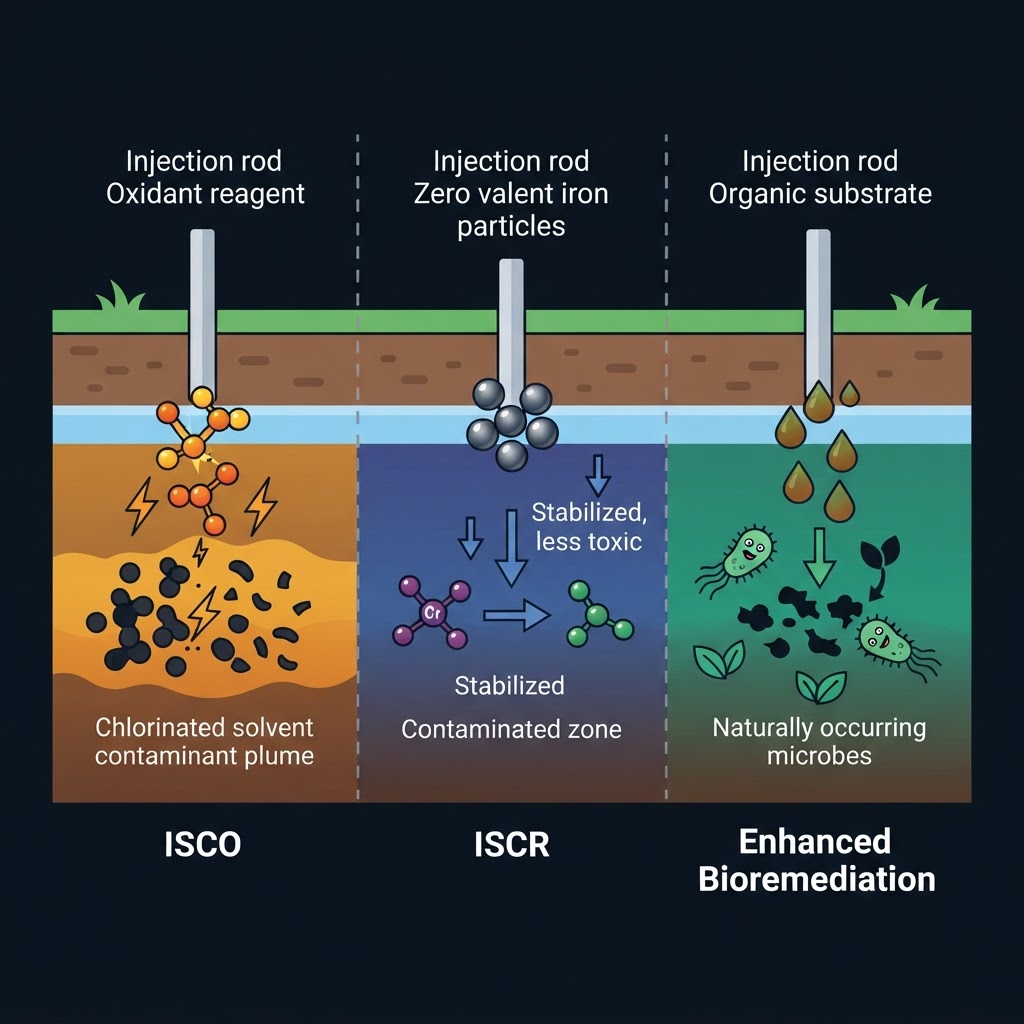
Three Technologies, Three Mechanisms
Each technology destroys contaminants through a different chemical or biological pathway.
ISCO — In Situ Chemical Oxidation
Chemical destruction using oxidants
Injects oxidants (activated persulfate, permanganate, hydrogen peroxide) that chemically destroy contaminants through oxidation reactions. Rapid treatment, effective for source zones.
Best For
- Chlorinated solvents (TCE, PCE, DCE)
- Petroleum hydrocarbons (BTEX, MTBE)
- High-concentration source zones
- Rapid treatment timelines
Common Reagents
ISCR — In Situ Chemical Reduction
Chemical transformation using reductants
Injects reductants (zero valent iron, EZVI) that chemically transform contaminants through reduction reactions. Creates strongly reducing conditions that can also support bioremediation.
Best For
- Chlorinated solvents in anaerobic conditions
- Hexavalent chromium
- Metals precipitation
- DNAPL source zones
Common Reagents
Enhanced Bioremediation
Biological degradation using microbes
Delivers organic substrates (electron donors) and sometimes bioaugmentation cultures to stimulate naturally occurring microbes that degrade contaminants through biological processes. Sustained, long-term treatment.
Best For
- Dissolved chlorinated solvent plumes
- Petroleum hydrocarbon plumes
- Long-term treatment programs
- Sites where microbial activity is viable
Common Reagents
Decision Matrix: Which Technology for Which Contaminant?
| Contaminant / Condition | ISCO | ISCR | Bioremediation |
|---|---|---|---|
| Chlorinated solvents (TCE, PCE) — source zone | ✓✓✓ | ✓✓ | ✓ |
| Chlorinated solvents — dissolved plume | ✓ | ✓✓ | ✓✓✓ |
| Petroleum hydrocarbons (BTEX, MTBE) | ✓✓✓ | — | ✓✓ |
| Hexavalent chromium (CrVI) | — | ✓✓✓ | ✓ |
| DNAPL source zones | ✓✓ | ✓✓✓ | ✓ |
| Metals (Pb, As, Cd) | — | ✓✓ | — |
| Rapid treatment needed | ✓✓✓ | ✓✓ | — |
| Long-term sustained treatment | ✓ | ✓✓ | ✓✓✓ |
| Low-permeability clay geology | ✓ | ✓ | ✓✓ |
✓✓✓ = Primary recommendation ✓✓ = Strong option ✓ = Viable option — = Not typically used
Combined Remedies: The Best of All Three
The most effective remediation programs often combine technologies in sequence. IET designs combined remedies that leverage each technology's strengths:
ISCO for rapid source zone destruction → bioremediation for sustained plume treatment
ISCR with zero valent iron → creates reducing conditions favorable for reductive dechlorination
ISCO persulfate → leaves sulfate byproducts that naturally support downstream bioremediation
EZVI for DNAPL source → releases hydrogen that fuels anaerobic bioremediation
Frequently Asked Questions
What is the difference between ISCO, ISCR, and enhanced bioremediation?
ISCO (In Situ Chemical Oxidation) uses oxidants like activated persulfate and permanganate to chemically destroy contaminants. ISCR (In Situ Chemical Reduction) uses reductants like zero valent iron to chemically transform contaminants. Enhanced bioremediation uses organic substrates and sometimes bioaugmentation cultures to stimulate naturally occurring microbes that degrade contaminants biologically. Each is appropriate for different contaminant types, geology, and treatment goals.
When should I use ISCO vs. bioremediation?
Use ISCO when you need rapid contaminant destruction, especially for high-concentration source zones with chlorinated solvents (TCE, PCE) or petroleum hydrocarbons. Use enhanced bioremediation when you need sustained, long-term treatment, especially for dissolved plume control and when site conditions support microbial activity. IET often combines both — ISCO for source treatment followed by bioremediation for plume polishing.
When is ISCR more appropriate than ISCO?
ISCR is preferred for contaminants that are more amenable to reduction than oxidation, such as hexavalent chromium, chlorinated solvents in anaerobic conditions, and certain metals. ISCR using zero valent iron creates a strongly reducing environment that can also support secondary bioremediation. IET evaluates geochemistry and contaminant speciation to determine whether ISCO or ISCR is the better fit.
Can ISCO, ISCR, and bioremediation be used together?
Yes. Combined remedies are increasingly common and often more effective than any single technology. IET routinely designs sequenced approaches: ISCO for rapid source zone destruction, followed by bioremediation for sustained plume treatment; or ISCR with zero valent iron that creates reducing conditions favorable for reductive dechlorination. The key is designing the sequence so each technology complements the others.
Which technology is most cost-effective?
Cost-effectiveness depends on site conditions. ISCO is typically most cost-effective for rapid source zone treatment. Enhanced bioremediation is often the most economical for large dissolved plumes. ISCR can be cost-effective for specific contaminants like chromium and chlorinated solvents in reducing geochemistry. IET provides free cost estimates through its AI Site Assessment Tool to help you compare options for your specific site.
