 Translate
Comparing Delivery Approaches for ISCO and ISCR Amendments
The same reagent can be delivered five different ways — and the delivery method often matters more than the reagent itself. This guide compares direct-push, permanent wells, soil mixing, recirculation, and gravity-fed systems for ISCO and ISCR amendments.
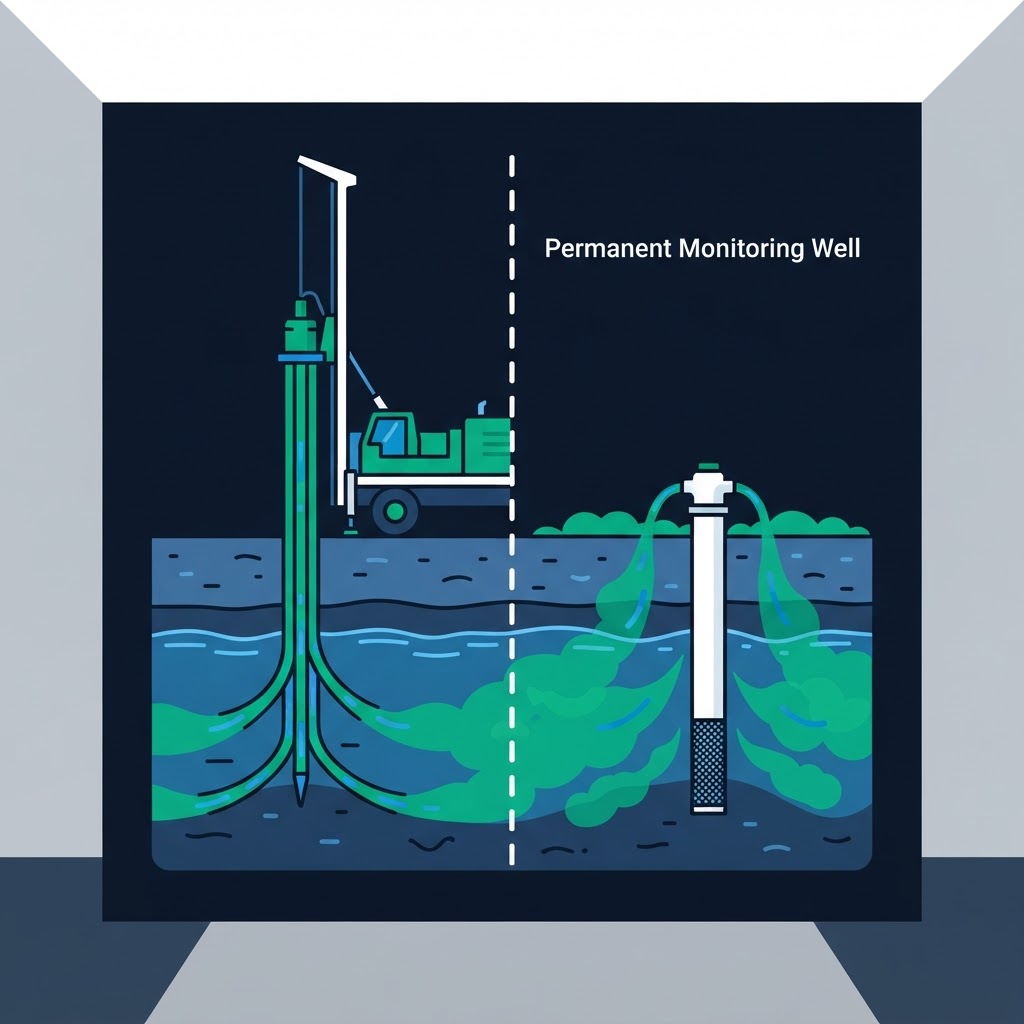
Five Delivery Approaches
Each approach has distinct advantages for ISCO and ISCR amendment delivery.
Direct-Push Injection
Reagent injected through steel drill rods
Geoprobe or DPT rig pushes rods to target depth; reagent is injected at precise intervals as rods are withdrawn. Most common delivery method for both ISCO and ISCR.
Best For
- Single-event ISCO/ISCR
- Unconsolidated soils
- Depths up to 100+ ft
- Grid-based source treatment
ISCO Application
Persulfate, permanganate, peroxide — all injectable
ISCR Application
ZVI slurries, dithionite solutions
Permanent-Well Injection
Reagent injected through dedicated wells
Pre-installed wells with screened intervals in the target zone. Reagent is injected through the well casing, allowing repeated treatment events and recirculation.
Best For
- Multi-event programs
- Deep or complex geology
- Recirculation systems
- Repurposed monitoring wells
ISCO Application
All oxidants — enables sustained delivery
ISCR Application
ZVI slurries, EZVI — repeated dosing possible
Soil Mixing (ISGS)
Reagent mechanically blended into soil
Large-diameter augers or excavator-mounted mixing heads blend reagent directly into contaminated soil. Ideal for low-permeability soils and high-concentration source zones.
Best For
- Clay and low-permeability soils
- NAPL source zones
- High-concentration areas
- Shallow to moderate depth
ISCO Application
Persulfate, permanganate — mixed as slurry or solid
ISCR Application
ZVI powder, Provect-IR™ — mixed directly into soil
Recirculation Systems
Extract, amend, and re-inject groundwater
Groundwater is extracted, mixed with reagent, and re-injected through permanent wells. Achieves sustained delivery and uniform distribution for large plumes.
Best For
- Large dissolved plumes
- Multi-event treatment
- Sustained reagent delivery
- Uniform distribution needs
ISCO Application
Persulfate, permanganate — continuous or batch recirculation
ISCR Application
ZVI slurry recirculation for sustained reducing conditions
Gravity-Fed & Low-Pressure Systems
Passive reagent delivery via gravity
Reagent is delivered through wells or trenches using gravity or low pressure. Slower but effective for shallow contamination and long-term passive treatment.
Best For
- Shallow contamination
- Long-term passive treatment
- Low-energy sites
- Vadose zone treatment
ISCO Application
Permanganate solution — gravity fed through wells
ISCR Application
ZVI slurry — gravity or low-pressure injection
Delivery Approach Comparison
| Factor | Direct-Push | Perm. Wells | Soil Mixing | Recirculation | Gravity-Fed |
|---|---|---|---|---|---|
| ISCO Compatible | ✓✓✓ | ✓✓✓ | ✓✓ | ✓✓✓ | ✓✓ |
| ISCR Compatible | ✓✓ | ✓✓✓ | ✓✓✓ | ✓✓ | ✓ |
| Single-Event Cost | Low | High | Med | High | Low |
| Multi-Event Cost | High | Low | N/A | Low | Low |
| Clay Geology | ✓ | ✓ | ✓✓✓ | ✓ | — |
| Deep Zones (>100ft) | ✓ | ✓✓✓ | — | ✓✓ | — |
| NAPL Source Zones | ✓✓ | ✓ | ✓✓✓ | ✓ | — |
| Distribution Uniformity | Good | Good | Excellent | Excellent | Fair |
IET Designs the Optimal Delivery Approach
With in-house drilling, injection tooling, and soil mixing equipment, IET can deploy any delivery method — or combine them — for your site. Our design team evaluates geology, contaminant distribution, and project goals to recommend the most effective and cost-efficient approach.
Get a Delivery Design RecommendationFrequently Asked Questions
What are the delivery approaches for ISCO and ISCR amendments?
ISCO and ISCR amendments can be delivered via direct-push injection (Geoprobe rods), permanent well injection, soil mixing (auger or excavator-based), gravity-fed systems, and recirculation systems. The choice depends on geology, contaminant distribution, depth, and whether single-event or multi-event treatment is planned. IET designs the optimal delivery approach for each site.
How does soil mixing differ from injection for ISCO delivery?
Injection delivers reagent as a liquid through drill rods or wells into the subsurface, relying on radial distribution through soil pores. Soil mixing uses large-diameter augers or excavator-mounted mixing heads to mechanically blend reagent directly into contaminated soil. Mixing is preferred for low-permeability clays, high-concentration source zones, and NAPL-impacted areas where fluid injection alone cannot achieve adequate distribution.
What is a recirculation system for ISCO or ISCR delivery?
Recirculation systems extract groundwater, mix it with reagent (persulfate, permanganate, or ZVI slurry), and re-inject it through permanent wells. This approach maintains sustained reagent delivery, achieves higher distribution uniformity, and is ideal for large dissolved plumes or sites requiring multiple treatment events. IET designs and operates recirculation systems for both ISCO and ISCR applications.
Can ISCO and ISCR amendments be delivered through the same injection points?
In many cases, yes. If a site requires both oxidation and reduction (e.g., ISCO for source zone followed by ISCR for metals stabilization), the same direct-push points or permanent wells can be used sequentially. However, the timing and sequencing must be carefully designed to avoid chemical interference. IET evaluates compatibility and designs sequenced delivery programs.
Which delivery approach is most cost-effective for ISCO?
Direct-push injection is typically the most cost-effective for single-event ISCO treatments because there is no well construction cost. For multi-event programs or large plumes, permanent wells or recirculation systems may be more economical over the project lifecycle. IET evaluates all delivery options during the design phase and recommends the most cost-effective approach for each site.
