 ترجمة
ترجمةIn Situ Geochemical Stabilization (ISGS)
IET's proprietary, exclusively licensed technology for NAPL remediation. ISGS uses modified sodium permanganate to physically encapsulate coal tar, creosote, and DNAPL in place — reducing contaminant flux without excavation.
Technology Overview
What is ISGS?
In Situ Geochemical Stabilization (ISGS) involves the use of modified sodium permanganate (NaMnO₄) developed for in-situ treatment of non-aqueous phase liquids (NAPL). When ISGS reagents are added to a contaminated aquifer, they react with organic (and certain inorganic) constituents of interest present as soil residues (such as NAPL or ganglia).
How It Works
Permanganate and other proprietary reagents are selected based on the particular characteristics of each site and are mixed on-site to form an aqueous solution that can be injected into an aquifer either through existing wells or by direct pressure technology. Depending on site conditions, ISGS reagent can also be delivered by soil mixing where mechanical blending achieves better contact with the NAPL.
The ISGS reagent flows freely through the subsurface in situ after injection, migrating through the treatment zone until it contacts an organic compound (such as NAPL or dissolved-phase contaminants). That contact initiates the crystalline formation process — the reagent reacts at the NAPL interface, precipitating stable mineral crusts that effectively "seal" the NAPL surface. This encapsulation reduces contaminant flux and immobilizes the flowable DNAPL in place, preventing further migration while partial mass removal occurs through oxidation of the more labile constituents.
The Process
Various reactions associated with ISGS processes serve to physically crust NAPL and rapidly reduce aquifer permeability. This stabilizes NAPL remnants and accelerates remediation by naturally attenuating dissolved contaminants and components of the contamination plume through source stabilization and flow reduction.
Birnessite Crust Formation
To confirm ISGS performance, delivery must effectively distribute reagent to the targeted zone and the formation of a Birnessite-like crust must be verified. Birnessite is an oxide of manganese and magnesium, along with sodium, calcium, and potassium, with the composition:
(Na,Ca,K)(Mg,Mn)Mn₆O₁₄ · 5H₂O
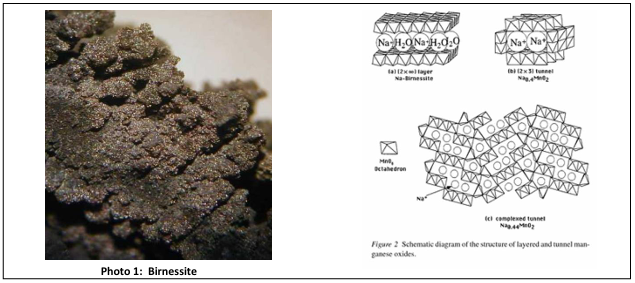
Field confirmation sampling has documented this crust in place. In one pilot, day-one sampling (traditional acetate liner advancement) confirmed reagent delivery and presence of the ISGS injectant down to 38 feet bgs, while residual hydrostatic pressure caused unconsolidated sands to "heave" into the tooling at greater depths. A day-five discrete sampling event overcame this limitation, capturing the entire injection profile (35–41 feet bgs) and confirming Birnessite-like crystallization and crust formation around globules of free-phase DNAPL and saturated soil.
Field-Documented Results
Source: observations and monitoring results recorded by IET field staff during the referenced projects. The creosote result below is a direct field observation (appearance, odor, and physical hardening) rather than an analytical measurement; the Fanwood, NJ results are analytical groundwater monitoring data. Last reviewed: October 2026 by IET technical staff.
Creosote Site — Solidification in 15 Days
At a creosote-impacted site injected by IET in September 2013, creosote observed above the peat layer prior to injection carried a strong odor. Fifteen days after ISGS injection, the same creosote had "solidified" into a stable, odorless mass — direct field evidence of the hardening and chemical weathering process.
Fanwood, New Jersey — Coal Tar & Heavy-End Petroleum
At a site near Fanwood, NJ impacted by historic coal tar and heavy-ended petroleum releases, IET injected ISGS across 44 direct-push points covering 8,955 square feet, treating soil and groundwater from 5–10 feet bgs. Ten wells with free product ranging from 1.22 to 5.37 feet thick showed zero free product within 30 days of injection, and post-treatment monitoring recorded reductions of up to 99.9% in naphthalene and 85–96% in targeted PAHs and BTEX compounds.
View Full Case StudyPerformance Data — Kopper's Inc. Superfund Site, Denver, CO
Field testing of ISGS technology treated a 75,000 ft³ (2,124 m³) area of creosote/pentachlorophenol NAPL. A single ISGS treatment yielded measurable reductions in both residual contaminant mass and leachable contaminant flux.
Field-measured data — source and review
Source: IET field performance records for the ISGS pilot at the Kopper's Inc. Superfund Site, Denver, CO. The "Background" and "Treated" values are analytical results from soil and groundwater samples collected before and after a single treatment event.
What these tables are: field measurements at the sampled locations. They are not modeled or projected values, and they are single-event results from one pilot area — not a projection of performance at other sites. Modeled projections appear separately under Estimated Treatment Longevity.
Last reviewed: October 2026 by IET technical staff.
| Contaminant | Background | Treated | % Reduction |
|---|---|---|---|
| LMW PAHs | 7,633.50 | 5,996.75 | 21% |
| HMW PAHs | 1,961.55 | 1,744.55 | 10% |
| TOTAL PAHs | 9,595.05 | 7,771.30 | 19% |
| PENTA | 236.00 | 55.67 | 76% |
| TOTAL CPs | 284.48 | 59.25 | 79% |
| Contaminant | Background | Treated | % Reduction |
|---|---|---|---|
| LMW PAHs | 34.41 | 12.75 | 73% |
| HMW PAHs | 6.05 | 0.11 | 99% |
| TOTAL PAHs | 40.46 | 12.86 | 79% |
| PENTA | 18.91 | 9.66 | 49% |
| TOTAL CPs | 23.38 | 10.41 | 56% |
Table 1 reports soil results (mg/kg) and Table 2 reports groundwater results (mg/L); percent reduction is the change from background to treated for each parameter. Both tables are field data from a single ISGS treatment event and should be read together with the source note above.
Mechanisms
- • ISGS immobilizes and "traps" NAPL in a geochemical crust
- • Proprietary reagents react with MnO₂ at the NAPL surface to form a stable precipitate shell
- • ISGS precipitate forms rapidly, within days, and is projected to remain stable for decades (modeled — see Estimated Treatment Longevity)
- • Reduces porosity by more than 80% and permeability by more than 90%
- • Geochemical reactions destroy dissolved-phase target compounds, causing "hardening" or chemical weathering of residual NAPL
Mass Removal + Reduced NAPL Mobility + Reduced Porosity = Flux Reduction (long-term NAPL stabilization)
Benefits
- • Liquid reagent can be applied via direct-push technology, wells, or soil mixing
- • More cost-effective for NAPL treatment than alternative technologies
- • Works quickly — results within days to weeks
- • May be surgically delivered to DNAPL zones
- • Applicable across a variety of lithologies
- • Impedes plume expansion both vertically and horizontally
- • Encourages plume contraction via accelerated natural attenuation
- • Easily piloted, field-demonstrated, and readily permitted with regulatory approval
- • Alternative to excavation — implemented without site disturbance
- • Delivered as a lump-sum, turn-key solution
Applications
Coal Tar
Creosote
PCBs
Certain Heavy Metals
Estimated Treatment Longevity
Modeled estimate — not a field measurement
Every figure in this section is an output of a longevity model that projects manganese release from ISGS mineral precipitates under the assumptions listed below. These are projections, not measured performance at any site. Field-measured ISGS results are reported above under Field-Documented Results and Performance Data.
Longevity modeling based on the release of manganese (as Mn⁺²) from ISGS mineral precipitates projects that the crust remains protective for decades. For a representative 1 m³ treatment volume, at an aquifer porosity of 20% and groundwater velocity of 2.5 cm/day, manganese removal proceeds at approximately 0.01%/year — corresponding to a modeled 2,596 years to full (100%) manganese removal and 260 years to 10% removal.
Source: IET longevity model (manganese release from ISGS mineral precipitates) with the inputs and assumptions listed below. Model last reviewed: October 2026 by IET technical staff.
| Treatment Volume (m³) | KMnO₄ Dosage (%w/w) | Mn Dosage (kg/m³) | Mn Solubility (mg/L) | GW Velocity (cm/d) | Mn Removal (%/year) | Time to 10% Mn Removal (yr) | Time to 100% Mn Removal (yr) |
|---|---|---|---|---|---|---|---|
| 1 | 2.44 | 12.72 | 0.55 | 2.50 | 0.01 | 260 | 2,596 |
Model inputs and assumptions: saturated aquifer solids density of 1,500 kg/m³; KMnO₄ dosage based on a 4.5% ISGS solution; Mn solubility estimated at near-neutral pH from treatability testing and literature values; a 10% loss of Mn-based mineral precipitates was assumed not to alter treatment efficacy.
Crust Chemistry
The ISGS precipitate shares structural characteristics with amphibole mineral groups, expressed by the general formula:
A₍₀₋₁₎B₂C₅T₈O₂₂(OH)₂
- A-site may contain Na or K
- B-site may contain Na, Ca, Mg, or Fe²⁺
- C-site may contain Mg, Fe²⁺/³⁺, or Al
- T-site is tetrahedrally coordinated and may contain Si or Al
- Hydroxyl ions can be replaced by Cl or F
There is a wide range of chemical substitution possible in the crystal structure — amphiboles of this type crystallize in igneous and metamorphic rocks, typically forming as long prismatic crystals, radiating sprays, and fibrous aggregates.
Ready to Discuss ISGS for Your Site?
Contact IET today to learn how ISGS can stabilize NAPL source zones at your MGP, creosote, or DNAPL site.
Request a Quote